Seedance 2.5 vs MiniMax H3 vs Kling 3.0: Same Prompt, Same Inputs, Real Test
A transparent same-prompt comparison of Seedance 2.5, MiniMax H3, and Kling 3.0 across cinematic and UGC video tests, with settings and limitations clearly reported.

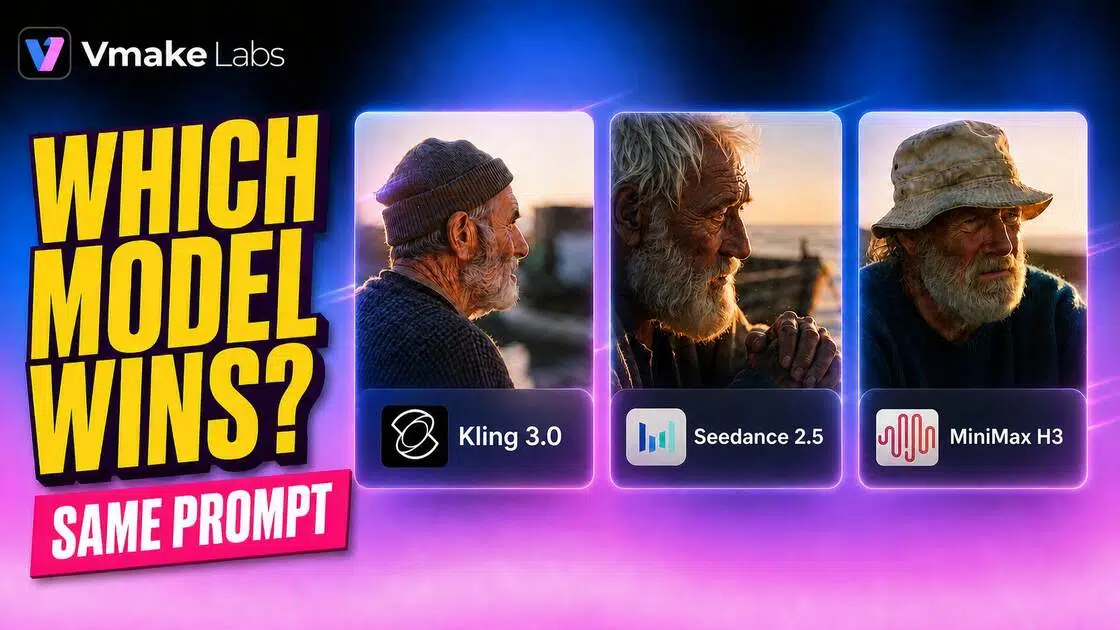
Comparisons of AI video models are easy to make badly. Different prompts, reference images, durations, plans, and post-processing can make a platform look better before the first frame is generated. This guide sets a reproducible test for Seedance 2.5, MiniMax H3, and Kling 3.0, then separates published facts from observed results.
Quick tip: Run the same prompt in Vmake Labs with the same aspect ratio, duration, and reference input. Compare the hook, motion, subject consistency, and final frame before judging visual style.
Seedance 2.5 vs MiniMax H3 vs Kling 3.0
Test Design
This comparison uses two separate test tracks. Their formats and success criteria are intentionally different.
Test track | Current status | Locked test settings | What it measures |
|---|---|---|---|
Cinematic portrait | Completed with the three supplied Artflo clips | 16:9, approximately 5 seconds, highest selected resolution | Subject identity, camera movement, lighting continuity, facial detail, and cinematic composition |
UGC product-commerce | Completed with the three supplied second-round clips | 9:16, approximately 10 seconds, highest selected resolution, same product reference image | Hook clarity, product visibility, creator-style authenticity, hand/product consistency, captions, and first-pass commercial usability |
A model that looks strongest in a cinematic portrait is not automatically the best choice for a UGC product video. The cinematic clips are a first-round portrait test, while the supplied UGC clips are evaluated as a separate shortened vertical-commerce test.
Model | Primary-source information | What it does not prove |
|---|---|---|
Seedance 2.5 | 30-second video generation, multimodal references, and precise editing workflows. | It does not prove every wrapper offers the same duration, resolution, price, or controls. |
MiniMax H3 | No authoritative public MiniMax page defining H3 specifications was verified during this research pass. | Aggregator tables and social posts should not be treated as official H3 documentation. |
Kling 3.0 | Up to 15-second video, native audio, multimodal input/output, reference-to-video, and in-video editing. | Company-reported capabilities do not predict every prompt’s output or every plan’s availability. |
If a model is accessed through a third-party platform, record the platform, model label, plan, date, and settings instead of presenting wrapper behavior as universal model behavior.
Same-Prompt AI Video Test

For a fair comparison, lock the conditions separately within each content track.
Cinematic test track
- Use the exact five-second fisherman prompt.
- Use 16:9 and the highest available resolution for each model.
- Record the actual duration, resolution, generation time, and model label.
- Score camera movement, portrait consistency, lighting, detail, and cinematic finish.
- Use the Seedance 2.5 generator output as the Seedance lane result for this run.
UGC product-commerce test track
- Use the same detailed UGC prompt and the same product reference image for all models.
- The source prompt is timecoded for 20 seconds, but the supplied exports are approximately 10 seconds. This article labels them as a 10-second shortened execution of the 20-second UGC prompt, not as a full 20-second script test.
- Use 9:16 and the highest selected resolution available in the run. Record the actual duration rather than relying on the target setting.
- All three supplied files contain an audio track, but this first-pass review evaluates sampled visual frames and commercial structure only; voice quality and lip sync remain unscored.
- Record generation time, resolution, caption rendering, product consistency, and any post-processing.
Cinematic portrait prompt
Close-up shot, shallow depth of field, cinematic slow zoom-in. An elderly fisherman with weathered skin and white beard, staring into the distance with a solemn expression. Golden hour warm side lighting, soft rim light, dust particles floating in the air. He slowly turns his head toward the camera. Masterpiece, photorealistic.
UGC product-commerce prompt
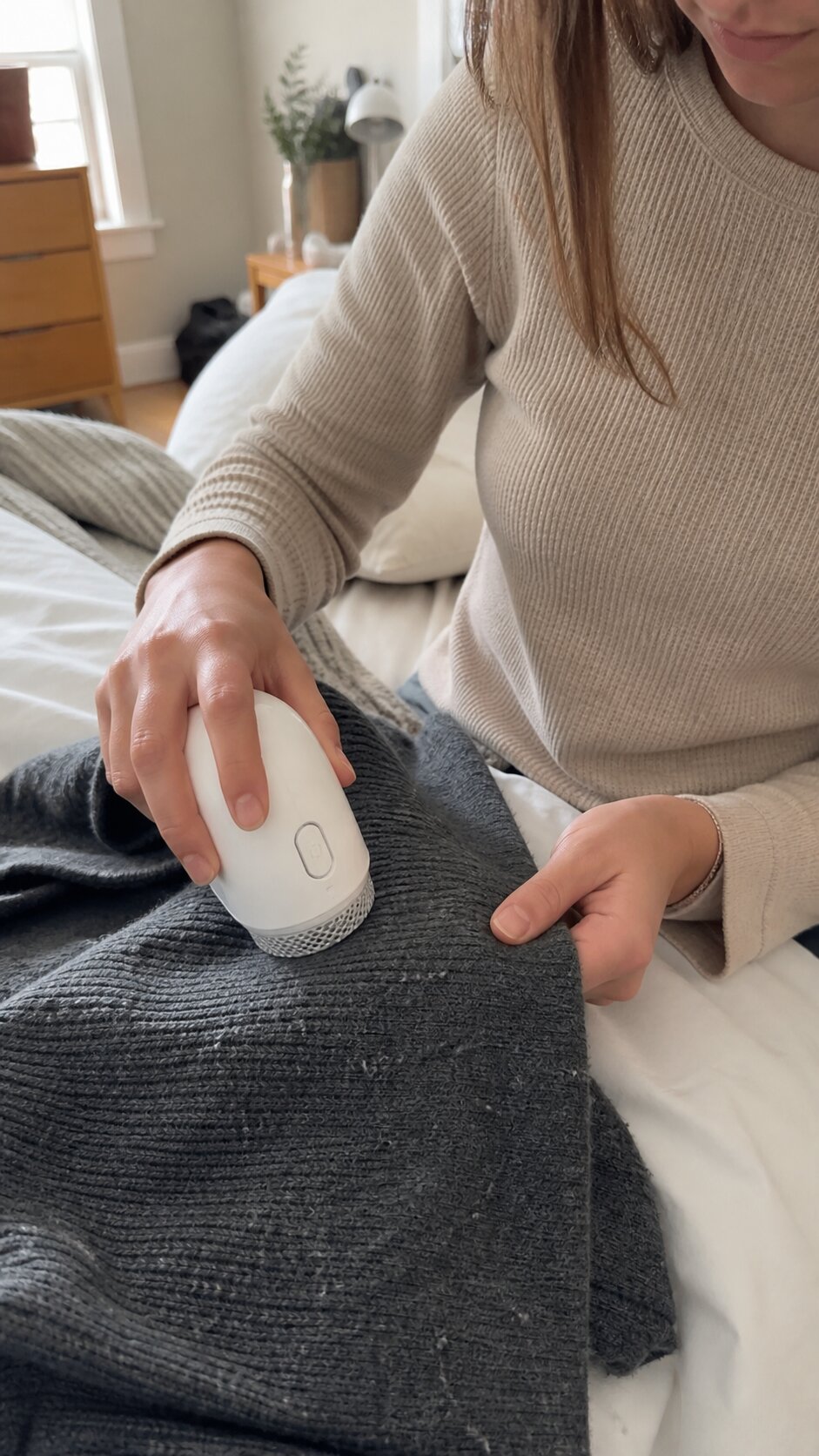
Create a 20-second vertical 9:16 TikTok Shop UGC video for a USB rechargeable portable fabric shaver.
A 26-year-old woman films herself at home using a smartphone front camera. The style is authentic TikTok UGC: casual bedroom, natural window light, slight handheld camera shake, realistic skin texture, imperfect framing, natural expressions, no studio lighting, no polished commercial look.
0–2 seconds: Start immediately with a close-up selfie shot. The creator holds up a fuzzy sweater and says: “Why did nobody tell me this could save my old sweaters?”
2–6 seconds: She shows the sweater covered with small fabric pills and looks mildly frustrated. The camera feels handheld and spontaneous.
6–12 seconds: Show her turning on the portable fabric shaver and slowly moving it across the sweater. Include a close-up of the device removing the visible pills. Keep the product shape, color, buttons, and logo consistent with the reference image.
12–17 seconds: Show a realistic close-up comparison of the treated area and untreated area. The creator smiles and says: “It took less than a minute, and now this sweater looks much neater.”
17–20 seconds: Return to the selfie angle. She holds the product beside her face and says: “If your clothes get fuzzy like mine, check it out through the link.”
Use natural conversational voice, realistic lip sync, subtle room ambience, and low-volume upbeat background music. Add short readable captions: “Old sweater rescue”, “Takes less than a minute”, and “Portable + rechargeable”. Leave clean space at the top and bottom for TikTok captions and shopping UI.
Do not exaggerate the result. Do not show a completely new-looking sweater. Do not invent reviews, fake comments, fake TikTok interface elements, or unrealistic transformations.
Professional commercial, studio lighting, stock footage, overacting, perfect transformation, brand-new sweater, fake testimonial, distorted hands, extra fingers, warped product, changing logo, unreadable text, unnatural lip sync, robotic voice, fake TikTok UI, fake comments, watermark.
The source UGC prompt is retained in full below for reproducibility. The supplied files are 10-second shortened executions of that 20-second prompt, so the article reports the actual exports rather than presenting them as full-script results. The same product reference image was used for every model.
AI Video Model Comparison Scoring Rubric
Score every dimension from 1 to 5, then apply the weights for the relevant test track. Do not combine cinematic and UGC scores into one average.
Cinematic portrait scorecard
Dimension | Weight | What a high score means |
|---|---|---|
Prompt and subject adherence | 20% | The fisherman, expression, setting, and head turn match the prompt |
Camera movement | 25% | The slow zoom-in is smooth and readable without unwanted cuts |
Identity and physical consistency | 20% | Face, beard, hat or clothing, skin texture, and body proportions remain coherent |
Lighting and atmosphere | 20% | Warm side light, rim light, depth of field, and dust remain visually consistent |
Detail and cinematic finish | 15% | The result has usable framing, texture, focus, and a coherent cinematic look |
UGC product-commerce scorecard
Dimension | Weight | What a high score means |
|---|---|---|
First-two-second hook | 20% | The viewer immediately sees the fuzzy sweater and understands the problem |
Product visibility and reference consistency | 20% | The shaver remains recognizable, with stable shape, color, buttons, and logo |
Demonstration and benefit clarity | 20% | The device visibly moves across the sweater and the benefit is understandable without exaggeration |
Hand and action reliability | 15% | Holding, turning on, shaving, comparison, and selfie gestures remain physically readable |
Creator-style authenticity | 10% | The result feels like casual TikTok UGC rather than a polished studio commercial |
Voice, lip sync, and audio | 10% | Speech, lip movement, room ambience, and music are natural and synchronized |
Captions and safe composition | 5% | Captions are readable and the top/bottom space remains usable for TikTok Shop UI |
If audio is disabled or unavailable for every model, mark the audio dimension N/A and redistribute its 10% equally between demonstration clarity and creator-style authenticity.
A weighted score is calculated as:
Weighted score = sum of (dimension score ÷ 5 × dimension weight)
Keep the raw 1–5 scores visible. A single overall number is useful for sorting, but it should never replace the notes explaining why a clip passed or failed.
AI Video Model Test Results
The following results are based on the three supplied Artflo clips and the run details provided for this article. The visual notes come from checking representative frames near the beginning, middle, and end of each clip. Generation time is the recorded Artflo generation time.
Model tested | Generation time | Output | Shared settings | Observed visual behavior |
|---|---|---|---|---|
Kling 3.0 | 1 min 55 sec | 3840 × 2160, 4K | 16:9, approximately 5 sec | Starts in a right-facing profile and moves toward a more frontal close-up. The hat, beard, skin texture, and warm backlight remain visually coherent across the clip. |
MiniMax H3 | 3 min 25 sec | 2560 × 1440, 2K | 16:9, approximately 5 sec | Uses a tight portrait composition and shifts from a three-quarter view toward a frontal close-up. The hat, beard, sweater, and sunset lighting remain recognizable across sampled frames. |
Seedance 2.5 | 6 min | 3840 × 2160, 4K | 16:9, approximately 5 sec | Begins with a side-profile composition and moves into a closer, more frontal shot. The beard, hair, skin texture, and warm lighting remain consistent, while the framing and facial angle change more noticeably. |
First-pass cinematic scores
These are editorial scores based on sampled frames and visible camera progression in the supplied clips. They exclude audio and should not be presented as an official benchmark.
Model tested | Prompt and subject | Camera movement | Identity consistency | Lighting and atmosphere | Detail and finish | Weighted visual score |
|---|---|---|---|---|---|---|
Kling 3.0 | 4.5/5 | 4.5/5 | 4.5/5 | 4.5/5 | 4.5/5 | 4.5/5 |
MiniMax H3 | 4/5 | 4/5 | 4/5 | 4/5 | 4/5 | 4.0/5 |
Seedance 2.5 | 4/5 | 4/5 | 4.5/5 | 4.5/5 | 4.5/5 | 4.3/5 |
The scores are intentionally conservative because the supplied run does not include audio settings, original reference files, seed values, or multiple samples per model. The main qualitative difference is camera progression: Kling shows the clearest profile-to-front movement in the sampled frames; MiniMax stays more tightly framed; the Seedance 2.5 output shows a stronger move into a frontal close-up in this run.
Kling 3.0: fastest turnaround in this run
Kling 3.0 completed the supplied generation in 1 minute 55 seconds, the shortest recorded time among the three clips. It also produced a 4K file. In the sampled frames, the camera movement is easy to read: the subject begins in profile and gradually turns toward the viewer. The face and clothing remain coherent enough for a short portrait shot.
That does not establish that Kling 3.0 is always faster or better. Queue load, account tier, prompt complexity, and platform settings can change generation time. The correct conclusion is narrower: Kling 3.0 was the fastest and reached 4K in this specific Artflo run.
MiniMax H3: consistent portrait framing at 2K
MiniMax H3 took 3 minutes 25 seconds and produced a 2K file in this run. Its output stays close to the subject’s face, with a clear transition from a three-quarter view toward a frontal portrait. The visual identity remains recognizable across the sampled frames, including the hat, beard, sweater, and warm sunset environment.
Because this result was generated through Artflo and no authoritative MiniMax H3 specification page was verified for this article, the result should be described as MiniMax H3 output observed in Artflo, not as a universal statement about MiniMax H3’s maximum resolution or performance.
Seedance 2.5: 4K output and longest recorded generation time
The Seedance 2.5 clip was used for the Seedance lane in this Artflo run. The clip reached 4K and kept the main facial identity and lighting coherent, but it took about 6 minutes to generate, the longest recorded time in this run. Its framing moves from a side profile with clasped hands into a closer frontal portrait, so the visual change is more pronounced than a simple static close-up.
This section describes the Seedance 2.5 file used in the comparison workflow.
Cinematic Video Test Decision
If your priority is... | Initial choice from this run | Why |
|---|---|---|
Shortest generation time | Kling 3.0 | 1:55 was the shortest recorded generation time |
Highest output resolution | Kling 3.0 or Seedance 2.5 | Both supplied files were 3840 × 2160 |
Tight portrait continuity | Kling 3.0 or MiniMax H3 | Both kept the portrait subject and warm lighting coherent in sampled frames |
Testing the Seedance workflow | Seedance 2.5 | It provides the Seedance lane result for this workflow |
Publishing a model-level conclusion | Not enough evidence yet | This is one short portrait test through Artflo |
UGC Video Test Results
The three supplied second-round clips are vertical 9:16 exports of approximately 10 seconds, using the highest selected resolution in the run. The source UGC prompt is written for 20 seconds with a 0–20 second timeline, so these files should be labeled 10-second shortened executions of the 20-second UGC prompt. They are useful for comparing the models’ ability to establish a hook, show the product, demonstrate the action, and close with a shopping CTA, but they do not prove how each model handles the complete 20-second script.
Model tested | Generation time | Actual output | First-pass observation |
|---|---|---|---|
Kling 3.0 | 3 min 09 sec | 2160 × 3840, 4K, 9:16, approximately 10 sec | Strong selfie hook and recognizable product demo, but the final generated caption is visibly garbled and would need replacement before publishing. |
MiniMax H3 | 6 min | 1440 × 2560, 2K, 9:16, approximately 10 sec | Complete UGC sequence with readable captions, visible product action, and only light cleanup indicated by the sampled frames. |
Seedance 2.5 | 11 min | 2160 × 3840, 4K, 9:16, approximately 10 sec | Hook, product close-up, demo, comparison logic, and closing product shot are all present and visually usable in this run. |
Kling 3.0 UGC video run test
The Kling clip opens with a clear selfie-style problem setup: the creator holds up a fuzzy sweater, so the viewer can understand the use case immediately. The middle section shows the fabric shaver close to the sweater, and the closing selfie keeps the product visible.
The main weakness is caption rendering. The final caption is visibly garbled or unreadable in the sampled end frame. That makes the clip less publishable even though the visual sequence itself is understandable. The practical fix is to replace the generated captions in post-production rather than rely on the model to render the final text. On the evidence available here, Kling is a promising draft but not a ready-to-publish UGC asset.
MiniMax H3 UGC video run test
MiniMax H3 produces the most complete-looking caption sequence among the three sampled clips. “Old sweater rescue,” “Takes less than a minute,” and “Portable + rechargeable” are readable in the checked frames. The creator, sweater, and shaver remain visible as the clip moves from the selfie hook to the product demonstration and back to the closing shot.
This output is commercially usable with relatively light cleanup from a visual-first perspective. The caveat is resolution: the supplied file is 2K rather than 4K, and this result should be described as the output observed through Artflo, not as a universal MiniMax H3 limit.
Seedance 2.5 UGC video run test
The Seedance 2.5 output keeps the main UGC beats visible in the supplied 10-second file: the opening sweater problem, a close-up of the shaver in use, and a final selfie/product shot. The captions are readable in the sampled frames, and the product remains recognizable across the sequence. The look is slightly softer in the opening frame, but the clip is coherent enough to use as a first-pass commerce draft.
For this specific Artflo UGC run, this is the only clip I would classify as immediately usable without a clearly visible visual repair. That is an editorial production judgment from one output per model, not a universal statement that Seedance is always better, and the file is labeled Seedance 2.5 in this version.
First-pass UGC scores
These are editorial scores from sampled frames and visible commercial structure. Audio and lip sync were not scored in this pass, so the 10% audio weight is redistributed equally to demonstration clarity and creator-style authenticity. The scores are not official benchmark results and should not be generalized beyond this run.
Model tested | Hook | Product consistency | Demo clarity | Hand/action | Authenticity | Captions/safe composition | Weighted visual-commercial score |
|---|---|---|---|---|---|---|---|
Kling 3.0 | 4/5 | 4/5 | 4/5 | 4/5 | 4.5/5 | 2/5 | 4.0/5 |
MiniMax H3 | 4.5/5 | 4/5 | 4.5/5 | 4/5 | 4/5 | 4.5/5 | 4.3/5 |
Seedance 2.5 | 4/5 | 5/5 | 5/5 | 4.5/5 | 4.5/5 | 4.5/5 | 4.6/5 |
The score is a workflow aid, not a conversion prediction. Kling’s score is pulled down mainly by unreadable end captions; MiniMax is the cleanest middle-ground output in this sample; Seedance 2.5 leads in this sample because it keeps the key commerce beats and readable captions together in one first-pass clip.
Seedance 2.5 Upgrade Context: What It Can and Cannot Change
The official Seedance 2.5 product description can be used as future upgrade context. This version records the current Seedance 2.5 run as 11 minutes generation time, approximately 10 seconds, 2160 × 3840, 9:16.
When the Seedance 2.5 model is available in the same workflow, replace this lane’s media, model name, and scores while keeping the test structure unchanged.
Limitations of This Seedance 2.5 Comparison
This is an initial comparison with one cinematic clip and one shortened UGC clip per model, not a full benchmark. The cinematic run used the same text prompt, 16:9 aspect ratio, approximately 5-second target, and highest selected resolution. The UGC run used 9:16 and approximately 10-second exports, while the source prompt is timecoded for 20 seconds. The supplied UGC files include audio tracks, but this pass did not score voice quality or lip sync. No multiple samples, seed values, or controlled retries were supplied, so the scores describe this run only.
The clips are also all short portrait scenes. They do not test product consistency, hands, multiple people, dialogue, text rendering, complex camera paths, or long-form continuity. A stronger follow-up should repeat the run with at least one product shot, one human-action shot, and one audio or dialogue shot.
How to Interpret and Extend This AI Video Model Comparison
A fair comparison is a method, not a dramatic verdict. In this Seedance 2.5 version, Kling 3.0 had the shortest recorded cinematic generation time, while Kling 3.0 and Seedance 2.5 reached 4K. In the shortened UGC run, Seedance 2.5 was the only first-pass clip I would classify as immediately usable without a clearly visible visual repair; MiniMax H3 was usable with lighter cleanup, while Kling needed caption replacement. These are observations from one Artflo run.
How to improve a Seedance 2.5 comparison test
A single product prompt is useful, but it cannot reveal every model’s strengths. A stronger comparison uses a small test set with different failure pressures:
Test scene | What it measures |
|---|---|
Product half-orbit | Shape, label, reflections, camera control, and motion stability |
Human walking toward camera | Anatomy, identity consistency, clothing, and foot motion |
Two-person conversation | Multi-subject consistency, turn-taking, and audio alignment |
Reference-image transformation | Reference adherence, composition preservation, and controlled change |
Use the same number of generations for every model. If a platform cannot accept the same input type or duration, record that as a workflow limitation instead of silently changing the test.
Separate AI video model behavior from platform behavior
For every output, record:
- model name and exact version label;
- access platform and plan;
- date and time zone;
- prompt text and reference-file names;
- aspect ratio, duration, resolution, and audio setting;
- generation count, failures, retries, and waiting time;
- whether the file was edited or enhanced after generation.
This information is important because a comparison between “Seedance 2.5” and “Kling 3.0” may actually be a comparison between two different wrappers, plans, queues, defaults, and export pipelines.
Normalize AI video generation cost and speed
Do not compare a free daily credit with a paid generation as if they were the same unit. Report cost in the unit the platform actually exposes, then normalize only when the calculation is transparent.
A simple report can include:
- Cost per usable clip: total credits or spend divided by the number of clips that passed the minimum quality threshold.
- Time to usable clip: queue time plus generation time plus required retries and editing.
- Failure rate: failed runs divided by total attempted runs.
- Control cost: the number of prompt revisions or reference changes needed before the result met the brief.
If prices are in different currencies or use different credit systems, publish the original values and the conversion date. Do not infer a precise cost when the platform does not expose enough information.
Choose an AI video model by content type
Use separate decision rules for the two tracks:
Test track | Primary decision criteria | Secondary criteria | Avoid concluding |
|---|---|---|---|
Cinematic portrait | Camera movement, identity consistency, lighting continuity | Detail, atmosphere, generation time | That cinematic quality predicts product-demo performance |
UGC product-commerce | First-two-second hook, product visibility, and demonstration clarity | Hand reliability, creator authenticity, voice/lip sync, captions, and safe composition | That a beautiful film look automatically converts better |
For the current cinematic run, a model should not be called the winner unless it is compared using the same prompt, the same target duration, and the same scoring weights. For the UGC run, the most usable first-pass clip in this sample is Seedance 2.5, while MiniMax H3 is a close practical option and Kling requires caption repair. This is an editorial workflow conclusion from one output per model, not a universal model ranking.
What publishable Seedance 2.5 comparison results should show
For each model and each test track, include:
- the exact prompt;
- the model and platform label;
- the aspect ratio, target duration, and actual resolution;
- generation time and number of attempts;
- the raw video or a representative frame;
- the score breakdown by dimension;
- one strength and one failure;
- whether audio, reference images, captions, or post-processing were used.
The article now has two result tables: one for the completed cinematic portrait run and one for the shortened UGC product-commerce run. The UGC table is explicitly limited to the supplied 10-second exports and should not be presented as a full 20-second script benchmark.
Interpretation rules for AI video model tests
How to write the cinematic conclusion
Use narrow, test-bound language such as:
- “Kling 3.0 had the shortest recorded generation time in this Artflo run.”
- “Kling 3.0 and Seedance 2.5 both exported 4K files in this run.”
- “The supplied clips maintained a recognizable portrait subject across sampled frames.”
- “The Seedance file is labeled Seedance 2.5 in this version.”
How to write the UGC conclusion
Use commercial workflow language instead of cinematic superlatives:
- “Model A kept the product visible through the key action.”
- “Model B delivered a more natural creator-style framing.”
- “Model C required more cleanup around hands, product edges, or captions.”
- “The result is a production-workflow observation, not a universal conversion claim.”
A model can win one track and lose the other. Publish the two conclusions separately and explain the trade-off.
For each model, include:
- the exact prompt;
- the same reference input;
- a short clip or representative frame;
- the selected settings;
- the best take and one typical failure;
- the score breakdown;
- the amount of retries and post-processing;
- the reason for the final recommendation.
Avoid showing only the best output. A model comparison becomes more credible when readers can see where the workflow fails.
Do not write “Model A is the best AI video model” based on one scene. Write a narrower conclusion:
- “Model A followed the product camera path more consistently in this test.”
- “Model B produced a more usable audio result in the conversation scene.”
- “Model C required fewer retries for the reference-image transformation.”
- “The result may not generalize to other prompts, plans, or model versions.”
The official information already gives different starting points: Dreamina’s Seedance 2.5 page describes 30-second, multimodal, reference-driven workflows; Kuaishou describes Kling 3.0 as supporting up to 15 seconds, native audio, and multimodal input/output. Those facts help define the test, but they do not replace the test itself.
FAQ
1. Is this an official benchmark?
No. This is an observational Artflo run, with one supplied clip per model per track—not an official benchmark.
2. Which model won the test?
Kling 3.0 was fastest in the cinematic run, while Seedance 2.5 was the most immediately usable first-pass UGC clip in this sample. These are track-specific observations.
3. Are the generation times and resolutions universal?
No. Queue load, account tier, plan, and platform settings can change them. The reported values describe the supplied Artflo files only.
4. How should I repeat this comparison?
Lock the prompt, references, aspect ratio, and target duration. Record actual duration, resolution, generation time, and post-processing, then score every model with the same criteria.
You May Be Interested

Seedance 2.0: What's New & How to Use It
123APPS Watermark Remover Review (2026): Pros, Cons, and Pricing

5 Best Valentine's Day Video Ideas for eCommerce in 2026
How to Create a YouTube Thumbnail? Create YouTube Thumbnails Using AI